
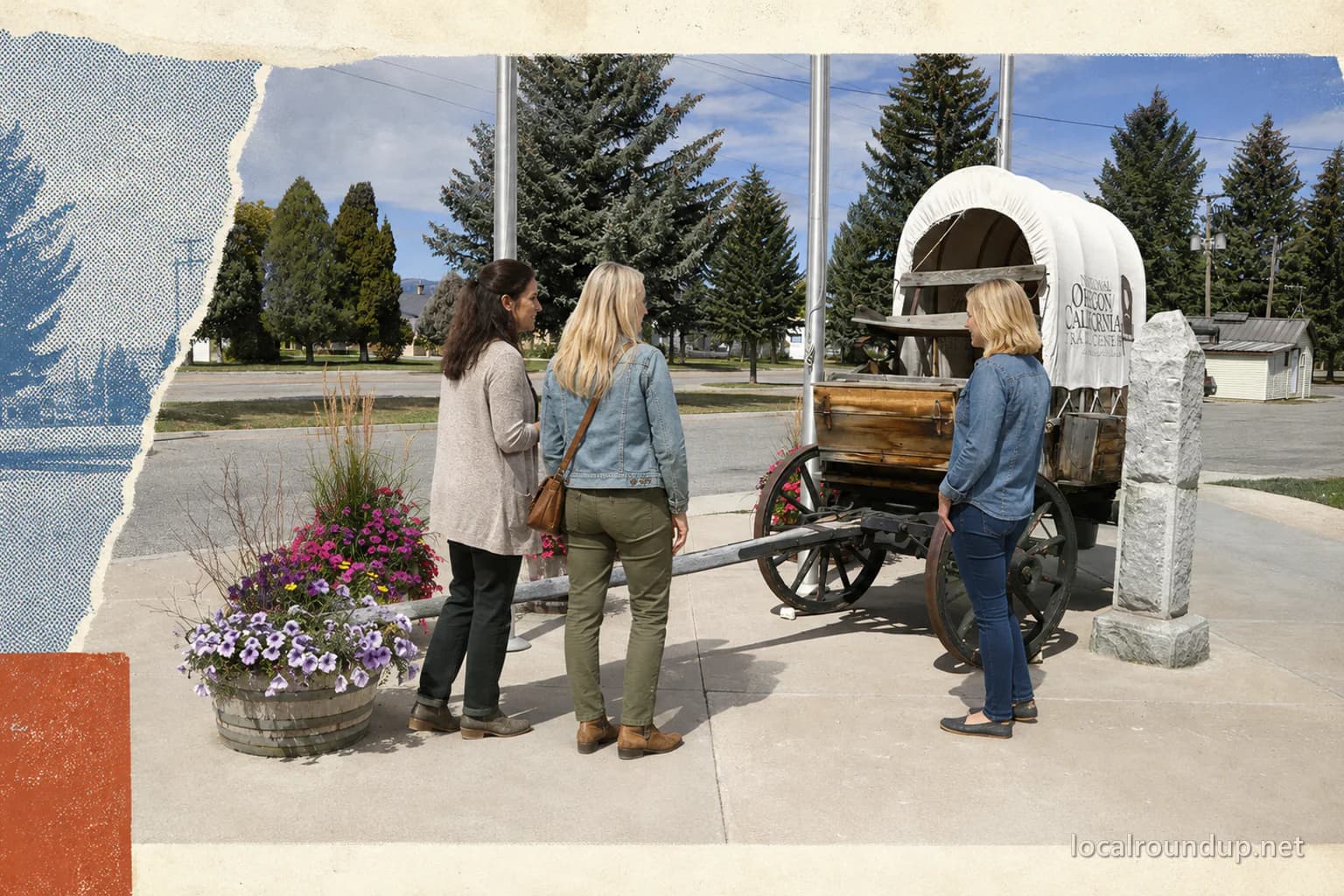
Plan the visit
The National Oregon/California Trail Center in Montpelier is built around interpretation. A traveler who allows only enough time for a lobby photograph misses the point. The center uses galleries and guided or staged experiences to explain emigrant decisions, trail travel, and the Bear Lake Valley's place on the route west.
Start by checking the official calendar, hours, and admission page. The schedule can change by season, and a group visit may need different arrangements from an individual walk-in. Decide whether the party wants the full interpreted experience or only the exhibits available during the chosen window.
Give the program enough time
The center describes an experience that follows a wagon-company story rather than a room of unrelated artifacts. That structure works best when visitors enter near the beginning and stay through the sequence. Ask staff how long the current program takes and when the next start is. Do that before paying or promising a meal reservation elsewhere.
Families should prepare children for spoken interpretation and historical scenes. This is not a ride in the amusement-park sense. The value comes from hearing choices and consequences attached to food, distance, weather, animals, and equipment. A child who gets one question to track, such as what had to fit in a wagon, has a better reason to listen.
Adults should distinguish interpretation from a claim that every scene recreates one documented family exactly. Living history combines sourced details into a visitor narrative. Use exhibit labels and the center's research material when a precise historical question matters.
Connect Montpelier to the real trail
The trail center gives context for nearby routes and landmarks, but it does not make every piece of surrounding land open for wandering. Follow National Park Service and local directions to recognized trail sites. Respect private property and do not treat an unmarked two-track as public access.
The National Park Service's Oregon Trail pages identify places to go in Idaho and explain the broader national historic trail. Read that material before adding a remote trail stop. A map pin is not enough for a safe or lawful detour.
If the group has only a half day in Montpelier, make the center the anchor and add one nearby stop after asking staff what is currently accessible. If the trip also includes Bear Lake or Minnetonka Cave, avoid stacking three scheduled experiences. The distances may look modest, but cave tours, museum programs, meals, and mountain roads consume the same hours.
Plan for the actual audience
History enthusiasts may want time for every label and staff conversation. Families with young children may do better with the central interpreted sequence and a shorter gallery pass. School or reunion groups should contact the center instead of assuming normal walk-in logistics apply.
When several households are meeting there, have one person confirm the program start and group arrangements with the center. That keeps the party from splitting between a walk-in visit and a separately scheduled experience.
Ask about accessibility for the current program. A building may be accessible while a particular staging area, sound environment, or group route still requires planning. Visitors with sensory needs should ask how much of the experience involves live interpretation and enclosed rooms.
Use current operations, not an old brochure
Montpelier's visitor season, ticket prices, and performance schedule can change. The official website is the starting point, but call when the trip depends on a specific program. Winter travel adds another variable. Check Idaho road conditions and local weather separately.
The center deserves more than a rushed stop because its subject is movement through this exact part of Idaho. Give the interpretation a defined block of time, then use the broader trail map to understand where the story sits. The building explains the route. It does not replace careful access planning for the landscape outside.
Budget time for the gift shop only after the program, not before it. More importantly, discuss the history in the car afterward. Ask which trail decision seemed hardest and whose perspective the interpretation centered. Westward migration affected Indigenous homelands as well as emigrant families. A useful visit leaves room for both the mechanics of travel and the consequences of that movement.
Check the details
Dates and rules can change. These are the organizer and venue pages used for the practical details in this guide.
- National Oregon/California Trail Center
`hours, admission, program format, contact and group planning`: National Oregon/California Trail Center, official site, https://oregontrailcenter.org/. Confidence: high for operator information, highly mutable. Contradiction: cached search results may show older seasonal schedules, so publication requires direct recheck.
- National Park Service
`Idaho trail places and public-access context`: National Park Service, Oregon National Historic Trail, Idaho places, https://www.nps.gov/oreg/planyourvisit/idaho.htm. Confidence: high. Contradiction: NPS place descriptions do not guarantee local operating hours.
- National Park Service
`trail history and planning`: National Park Service, Oregon National Historic Trail, https://www.nps.gov/oreg/index.htm. Confidence: high. Contradiction: none found.
- Hero image: Paul Hermans
Hero collage adapted from Paul Hermans' photograph under CC BY-SA 3.0; source person and vehicles removed, then cropped, recomposed, and combined with generated editorial elements. The adaptation is distributed under CC BY-SA 3.0.
- Hero image license: CC BY-SA 3.0
License terms for the credited source photograph. The modified collage adaptation is distributed under the same CC BY-SA 3.0 license.